THE engineering behind Croquest's 2026 project
Engineering is more than knowing how something works. It’s knowing what to do with that knowledge.
A successful engineer takes the concepts learned in the classroom and turns them into something tangible, something that works, fails, and, eventually, becomes real. For the CroQuest design team and the students at the 2026 Imagination summer camp, that process began with a camera.
A collaboration between Virginia Tech’s Competitive Robotics Organization (CRO) and the Center for Engineering Excellence and Discovery (CEED), CroQuest brings engineering students together to create hands-on experiences for younger students. One of its programs, Imagination, is a week-long summer camp focused on Electrical and Computer Engineering fundamentals, where students move beyond learning about engineering and actually build something tangible.
For the 2026 project, the CroQuest team returned to an idea the program had previously explored: a camera. One that will be further enhanced and accessible to students with little to no engineering experience.
The result was a camera combining electronics, programming, soldering, artificial intelligence, and graphic design. But before the students could build it, the CroQuest team had to build it themselves.
Designing for Students
The project began with a deceptively simple question: What would an engineering project look like for someone with almost no engineering experience?
The team wanted students to have enough components to solder and enough functionality to interact with without making the device overly complicated. The final design centered around a printed circuit board (PCB), two micro controllers (ESP32 and ESP32-CAM), a screen, buttons, a battery, and a charging module.
The camera also incorporated AI. The software team integrated Google Gemini through an API, allowing the camera to analyze images and answer questions about them.

"If a student made a mistake while soldering, a damaged component could be replaced without replacing the entire board.”
Designing the camera required balancing technical capability with educational value. The team considered time, cost, and reliability while also thinking about what would be manageable for seventh- and eighth-grade students.
One Team, Four Disciplines
Behind the camera was a team of eight students working across four areas: software, electrical, mechanical and graphic design.
The software team consisted of Emran Saidi, Salif Fofana and Ishita P., with Saidi serving as software lead. Avi Chowdhury and Jijun Niu worked on the electrical side. Morgan Weidling and Rachel Neathery handled graphic design, while Timothy Ellis worked on the project’s mechanical elements.

Although each member had a defined role, the project required collaboration across disciplines. The team developed a strong dynamic that allowed them to work together effectively and produce a final product they were proud of. As CroQuest’s Chief Engineer, Emran Saidi, described it, the team was “so connected.”
The team also received support from Abigail Middleton, Assistant Director of Precollege Outreach and Recruitment at CEED, who served as the group’s supervisor and provided support from CEED throughout the project.
Engineering Under Constraints
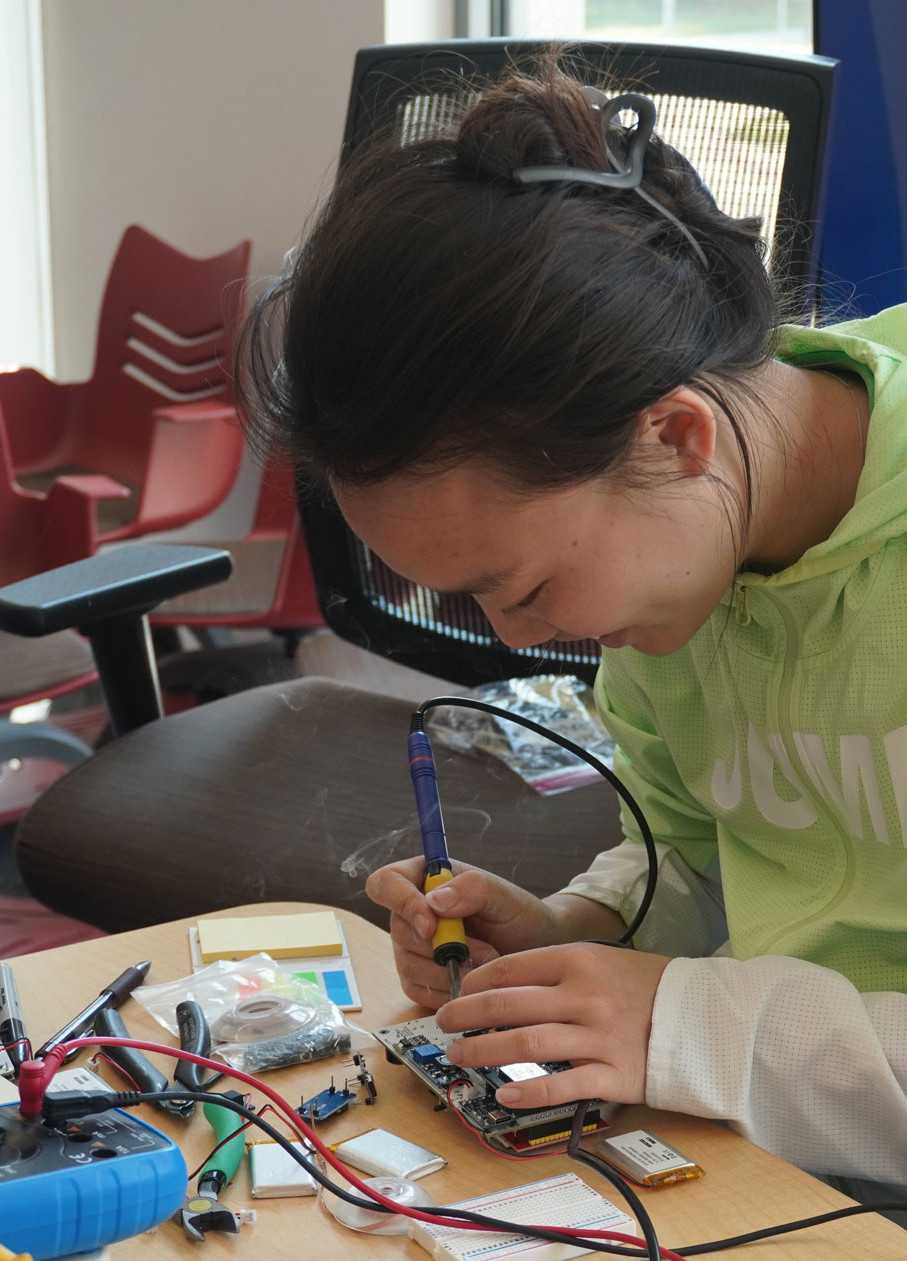
The team also had to design the camera with safety and repairability in mind. Rather than permanently soldering the micro controllers and screen onto the PCB, they incorporated removable connections. If a student made a mistake while soldering, a damaged component could be replaced without replacing the entire board.
For a project designed for students with little or no STEM experience, failure had to be part of the design. Students needed room to make mistakes and learn without making the entire project unusable.
The camera itself also went through an iterative design process. The team tested components, adjusted the hardware, and refined the PCB as they worked toward the final product. Each change helped reveal what worked, what did not, and what needed to change next.
“What engineering looks like in practice: a first attempt, followed by testing, failure, redesign, and improvement.”
From Engineers to Instructors
Once the hardware and software were ready, the team moved from working as engineers in the CRO lab in Durham Hall to becoming instructors at Imagination.
The camp lasted one week, with materials organized into dedicated boxes for each day. Students began by practicing soldering before progressing to more advanced parts of the camera. The team prepared materials before each day and reorganized them afterward to keep the week running smoothly.
Testing was equally important. The team checked electrical components, tested the mechanical fit of the parts, and conducted software testing, particularly on the AI system and its safety features.

The preparation mattered because many campers had little or no previous experience with soldering or engineering. For some, Imagination was their first opportunity to work with these skills in a hands-on setting.
And the camp extended beyond soldering. Students explored graphic design, created videos related to their activities, and were introduced to software concepts through game editing. The team also incorporated hidden features into the camera to add an element of surprise.
When It All Came Together
After weeks of designing, prototyping, testing, and troubleshooting, the most rewarding moment came at the end of camp: when every student had finally made their own camera.
For the team, watching students use the finished devices transformed the project from a collection of circuit boards and code into something tangible. After spending so much time developing individual components, the finished cameras demonstrated that all those pieces could come together into something real.
That moment captured the larger purpose of CroQuest. The project was not simply about creating a camera; it was about creating an engineering experience that students could participate in from beginning to end.
A student could start the week without knowing how to solder, work through mistakes with unfamiliar technology, and finish the week holding a device they helped build themselves.


The camera represents an evolution of an idea CroQuest had explored previously, but the new team pushed the concept further through updated hardware architecture, a student-tailored design, and AI capabilities.
More importantly, the project demonstrated what engineering looks like in practice: a first attempt, followed by testing, failure, redesign, and improvement.
For the students who built the cameras, the most important result may not have been the device itself. It was the realization that they could take an idea, learn from their mistakes, and turn it into something they could hold in their hands.


Comments